 44 7897 074717
Research Article - Journal of Food Technology and Preservation (2025) Volume 9, Issue 1
Contribution of traditional techniques in the stabilization of raw milk in the Sahel of Niger.
Issoufou Amadou1*, Oumarou Samna Soumana1, Ibrahim Halilou Amadou2, Mahamane Nouhou Bazanfare3
1Laboratory of Nutrition, Food Sciences and Technologies, Dan Dicko Dankoulodo University of Maradi, Maradi, Niger
2Laboratory of Ecology and Management of Sahelo-Saharan Biodiversity, University Andre Salifou of Zinder, Niger
3Laboratory of Hygiene, Food and Nutritional Sciences Research, Abdou Moumouni University of Niamey, Niger
- *Corresponding Author:
- Issoufou Amadou
Laboratory of Nutrition, Food Sciences and Technologies,
Dan Dicko Dankoulodo University of Maradi,
Maradi,
Niger
E-mail: amadou.issoufou@uddm.edu.ne
Received: 26-Nov-2024, Manuscript No. AAFTP-24-153385; Editor assigned: 29-Nov-2024, AAFTP-24-153385 (PQ); Reviewed: 16- Dec-2024, QC No. AAFTP-24-153385; Revised: 26-Jan-2025, Manuscript No. AAFTP-24-153385 (R); Published: 03-Feb-2025, DOI: 10.35841/2591-796X-9.1.271
Citation: Amadou I, Soumana OS, Amadou IH, et al. Contribution of traditional techniques in the stabilization of raw milk in the Sahel of Niger. J Food Technol Pres. 2025;9(1):271.
Abstract
This study was conducted in the city of Maradi and the department of Konni in Niger. Its objective is to study the different traditional methods of stabilizing raw milk in Niger to improve them. The method consisted of conducting individual interviews. There were 200 respondents, including 100 in Maradi and 100 in Konni. The analysis showed us that this is a predominantly female activity. In Maradi, the age range of 15 to 30 represents the majority while in Konni, the most represented age range is 39 to 47 years. In both sites, their main activity is based on livestock farming for the majority with 66% in Maradi and 50% in Konni respectively. The different traditional methods of preservation found are 4 in number: Preservation with cowpea (Vigna unguiculata) grains, with guinea pepper, with ginger (Zingiber officinale), and with chili (Capsicum annuum). In both sites, knowledge of preservation methods with cowpea grains and Guinea pepper (Xylopia aethiopica) exceeds other preservation methods. The maximum preservation time chosen by most people surveyed is 4 days with 46% in Maradi and 67% in Konni. The stabilization method with guinea pepper is the best known on both sites. The place of procurement of milk is Rouga (breeding site); i.e. 92% in Maradi and 71% in Konni. Producers as well as small traders use the same stabilization methods. Overall, the stabilization method with guinea pepper is the most appreciated. It is followed by stabilization with cowpea grains. The laboratory experiment showed us that the stabilization method with cowpea grains is the most effective with a lower Dornic degree. We can conclude that the degree of stabilization of raw milk varies on the one hand, with the product used to preserve it, and on the other hand, with the temperature depending on the storage time.
Keywords
Raw milk, Maradi and Konni, Guinea pepper, Cowpea, Ginger, Chili, Sahel.
Introduction
Located in West Africa, Niger, a Sahelian country, covers an area of 1,267,000 km2. Its population is approximately 27.2 million inhabitants [1]. With a Sudanese-type climate that alternates between two seasons (a long dry season from October to May and a short rainy season from May to September). Livestock farming is one of the fastest-growing agricultural subsectors in the agricultural sector and is a profitable activity, that brings in income and useful by-products (especially milk) to the household. Indeed, this activity is effective in fighting against poverty in the region, its contribution is on average 15% to household income and 25% to meeting food needs [2-4]. Niger has a culture of consuming milk and dairy products; its milk production is 1.5 billion liters per year, including about 500 million liters of cow's milk according to national statistics of the country [5].
However, there is a considerable increase in the demand for animal proteins. Animal milk is one of the most accessible sources of protein. It plays an important role not only nutritionally, but also economically and socio-culturally. In the most remote villages that practice livestock farming, livestock farmers produce abundant milk during the high lactation period [6,7]. Milk is a very fragile product because it is rich in nutrients and water; it therefore represents an excellent culture medium for many microbes. The action of particular microorganisms is sometimes sought to curdle milk for example, but in most cases, they are undesirable; in fact, they alter the milk, making it unfit or even dangerous for human consumption. For this, it is more than necessary to use methods to stabilize milk [8].
Despite the role played by milk production in the country's economy, it is clear that the latter is faced with many factors slowing down its momentum, including microorganisms present in milk forming a complex ecosystem. The microorganisms can be naturally present or accidentally by manipulation, and their multiplication under the action of temperature, the lack of hygiene at the place of production, and the absence of an effective conservation system limiting the development of microorganisms during the conservation time [9]. On the other hand, since 1995, the Codex Alimentarius has placed restrictions on the international marketing of dairy products whose milk has initially undergone lactoperoxidase treatment (s-LP) [10]. Thus, breeders use several traditional methods to stabilize raw milk. However, in Niger, there is no official scientific study on traditional practices for preserving raw milk, hence the interest of this study whose objective is to contribute to improving the conservation of raw milk in the Sahel of Niger.
Materials and Methods
Type of study
This is a diagnostic study of an experimental nature; it was conducted in the cities of Maradi and Konni in the Sahel of Niger.
Data collection
The diagnostic survey data were collected through a semi-structured individual questionnaire. The non-probabilistic snowball method was used with the main target to interview were farmers and milk sellers [8]. As part of this study, survey forms were developed to enable the collection of individual information.
Laboratory test
Both technical materials (Mohr burette and its support, a sodium hydroxide solution, distilled water, a bottle of 0.05% phenolphthalein, a 100 mL graduated cylinder, a 10 mL cylinder, a beaker labeled milk, a beaker labeled dosage, a water heater, a 4 L can, 1 L bottles, a funnel, a fine mesh sieve to filter the milk, pH paper, a scale, an oven), and biological (Milk, Vigna unguiculata with (1 g/L milk), Xylopia ethiopica (1.2 g/L milk), Capsicum annuum (1.3 g/L milk), and Zingiber officinale (2 g/L milk)) were of technical grade.
Methods
Initially, the milk was collected in 4L cans previously washed with hot water, from the breeders of the Maradi breeders’ center. Thus, a quantity of 2.5 L was distributed into 5 of 1L bottles, with a proportion of 0.5L each. The 4 stabilization products were each incorporated into one of the 1L bottles as follows: Vigna unguiculata grains (1 g/L), Xylopia ethiopica (1.2 g/L), Capsicum annuum (1.3 g/L), Zingiber officinale (2 g/L) and the fifth bottle constitutes the control bottle (no addition of stabilization products). The experiment was carried out at room temperature (33 ± 5°C) and 4°C (in a refrigerator). At room temperature, the bottles are not closed with caps but with clean coton. The titration was carried out every day by taking a volume of 30 mL in each sample, and the experiment was repeated three times.
The Dornic degree in milk of the samples at room temperature and refrigerator were determined for 5 days. A sample of milk is titrated with a potassium hydroxide solution. First, the burette is filled with the potassium hydroxide solution, and the liquid level is adjusted to the zero level of the burette by pouring the excess into the beaker. Using a measuring cylinder, 20 mL of milk is taken and poured into the beaker. 100 mL of distilled water was added using a graduated cylinder, 30 mL was taken and 3 drops of phenolphthalein (0.05%) were added. Then, the beaker was placed under the burette pour the potassium hydroxide solution quickly until reaching the turning point for at least 10 seconds. The value of the poured potassium hydroxide volume is then noted. Empty the dosing beaker, and repeat the same manipulation as before. And for the samples stored at room temperature and in the refrigerator were carried out in triplicate per day for 5 days each.
Statistical analysis
All experiments were conducted in triplicates and statistical analysis was performed using IBM-SPSS Inc. Software (version 25.0). One-way analysis of variance (ANOVA) was used to determine significant differences between means, with significance the level taken at (P<0.05). Duncan test was used to compare multiple means, with the significance level P<0.05. The chi-square test and hierarchical ascending classification were done with R software version 4.2.3.
Results
The survey revealed that predominantly females represented 74% and 26% of men in Maradi and 100% of women in Konni (Figure 1).
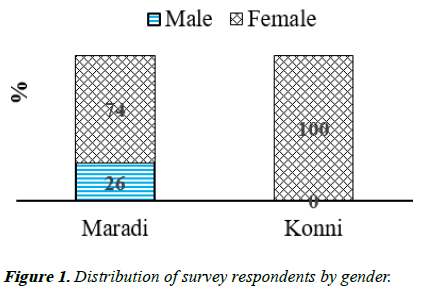
Figure 1: Distribution of survey respondents by gender.
This study shows that the age groups of our respondents vary from 15 to 75 years in Maradi and from 27 to 62 years in Konni. The most represented age group is that of 15 to 30 years or 52% in Maradi and in Konni the most represented is that of 39 to 47 years or 50%.
The results of the survey showed that Guinea pepper (94%) was the most used, followed by chili (81.5%) and cowpea (63%), and ginger was the least used with only 2% (Figure 2).
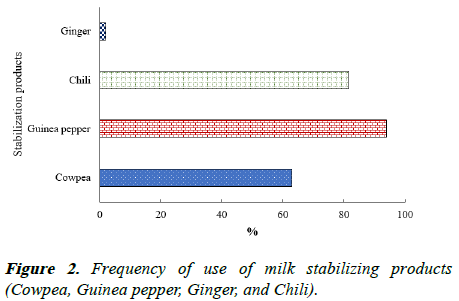
Figure 2: Frequency of use of milk stabilizing products (Cowpea, Guinea pepper, Ginger, and Chili).
There is a significant difference (p-value=0.0000) between the city and the preference for the traditional milk stabilizer used. The results demonstrated a very strong association between the city of Konni on the preference for chili pepper. The city of Maradi is strongly associated with the preference for Guinea pepper and a weak positive association with cowpea (Figure 3).
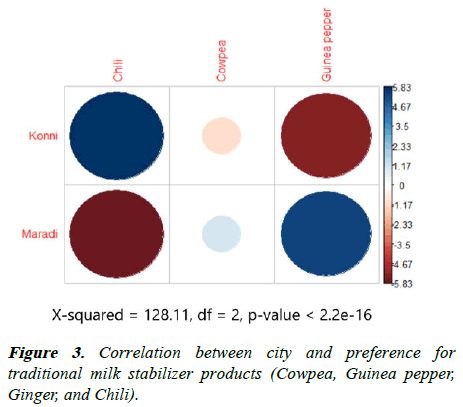
Figure 3: Correlation between city and preference for traditional milk stabilizer products (Cowpea, Guinea pepper, Ginger, and Chili).
It was found significant difference (p-value=0.000) between ethnicity and preference of these traditional milk stabilizers used. The results show that there is a very strong association between the Hausa ethnic group and the preference for Cowpea. The Fulani ethnic group is strongly associated with the preference for Guinea pepper and chili; the other ethnic groups have an association with the preference for Guinea pepper and cowpea (Figure 4).
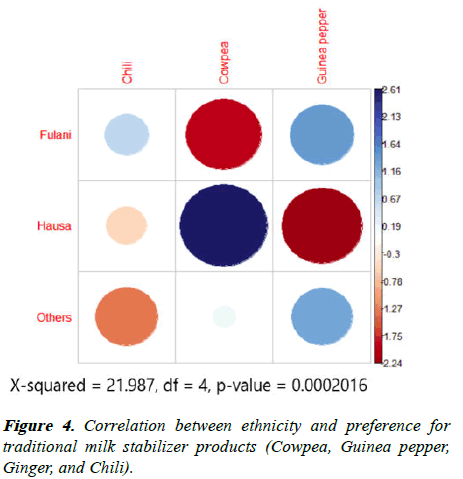
Figure 4: Correlation between ethnicity and preference for traditional milk stabilizer products (Cowpea, Guinea pepper, Ginger, and Chili).
The classification carried out on the survey individuals reveals 5 classes (Figure 5).
Class 1 (cluster 1) represents individuals sharing the high values for the variable cowpea and the low values for Guinea pepper and Chili from the most extreme to the least extreme. These are the Fulani ethnic group with no level of education in the city of Maradi.
Class 2 (cluster 2) showed individuals sharing variables whose values do not differ significantly from the average; that is the other ethnic groups with Koranic and primary education levels in the city of Maradi.
Class 3 (cluster 3) comprises individuals sharing high values for the variable ginger, and low values for the variable Chili pepper. These are the members of the Hausa ethnic group with a secondary level of education and single from the city of Maradi.
Class 4 (cluster 4) appeared for individuals sharing high values for the Guinea pepper variable, and low values for the cowpea and ginger variables from the most extreme to the least extreme. This class includes the Fulani with no level of education in the city of Maradi.
Class 5 (cluster 5) represents individuals sharing high values for the chili and Guinea pepper variables from the most extreme to the least extreme. This class concerns the Hausa ethnic group with a Koranic and primary level of education in the city of Konni.
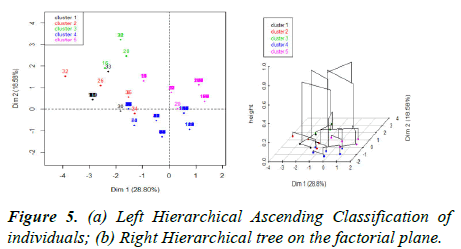
Figure 5: (a) Left Hierarchical Ascending Classification of individuals; (b) Right Hierarchical tree on the factorial plane.
The monitoring of stabilization according to the products (cowpea, guinea pepper, ginger, and chili) used by comparison of the average Dornic acidity between products is shown in Table 1.
| Times | |||||
|---|---|---|---|---|---|
| Stabilizers | Day 1 | Day 2 | Day 3 | Day 4 | Day 5 |
| Cowpea | 21.06a ± 0.00 | 21.06a ± 0.00 | 25.92a ± 0 | 34.02a ± 0 | 42.66a ± 0.93 |
| Guinea pepper | 21.06a ± 0.00 | 25.92a ± 0.00 | 42.12b ± 0 | 75.60b ± 0.87 | 81.54b ± 0.93 |
| Ginger | 21.06a ± 0.00 | 25.92a ± 0.00 | 42.66b ± 0,93 | 78.84c ± 1.87 | 91.26c ± 0.93 |
| Chili | 21.06a ± 0.00 | 25.92a ± 0.00 | 35.64a ± 0.00 | 75.60b ± 0.93 | 98.04d ± 0. |
| Control | 22.68a ± 0.00 | 32.40a ± 00.00 | 62.10d ± 0.935 | 78.84c ± 1.87 | 86.94c ± 2.47 |
| P-value | -- | -- | 0.000*** | 0.000*** | 0.000*** |
| ***: Highly significant; --: Does not follow a normal distribution; Values are means ± standard deviation of three determinations. Columns with different letters indicate statistical differences (P<0.05). Values followed by the same letter (a, b, c, d) in the same column are not significantly different (P<0.05). | |||||
Table 1. Comparison of the average Dornic acidity between the different kinds of kinds of milk containing stabilizers (cowpea, guinea pepper, ginger, and chili) stored at a temperature of 4°C.
From the results in Table 1, there is no difference in effect between the four stabilizers during days 1 and 2. The difference in means is statistically significant on days 3; 4 and 5, and cowpea has the lowest mean.
| Times | |||||
|---|---|---|---|---|---|
| Stabilizers | Day 1 | Day 2 | Day 3 | Day 4 | Day 5 |
| Cowpea | 80.46a ± 4.07 | 123.12a ± 9.72 | 172.80a ± 4.07 | 214.38a ± 2.47 | 249.48a ± 3.24 |
| Guinea pepper | 89.10a.b ± 10.62 | 132.84a.b ± 8.57 | 172.80a ± 11.37 | 212.76a ± 4.94 | 238.68b ± 4.94 |
| Ginger | 89.64b ± 6.48 | 136.08b ± 3.24 | 190.08b ± 4.94 | 222.48a ± 4.94 | 260.82c ± 1.62 |
| Chili | 89.64a.b ± 9.89 | 136.08b ± 3.24 | 174.42a ± 2.47 | 217.62a ± 8.92 | 245.16b.a ± 4.94 |
| Control | 101.52b ± 8.15 | 139.32b ± 3.24 | 169.02a ± 7.30 | 213.84a ± 4.28 | 252.18a ± 2.47 |
| P-value | 0.051 | 0.077 | 0.026* | 0.268 | 0.000*** |
| ***: Highly significant; *: significant; Values are means ± standard deviation of three determinations. Columns with different letters indicate statistical differences (P<0.05). Values followed by the same letter (a, b, c) in the same column are not significantly different (P<0.05). | |||||
Table 2. Comparison of the average Dornic acidity between the different kinds of milk containing stabilizers (cowpea, guinea pepper, ginger, and chili) and stored at ambient temperature.
The results revealed (Table 2) a significant difference on the 3rd and 5th days among the samples. On the 5th day, Guinea pepper has the lowest mean; however, ginger has the highest mean value.
Discussion
The results obtained from this study showed that more women than men practice this activity. Indeed, women represent 74% of the total population, against 26% of the men in Maradi and 100% of the women in Konni. The age of the people surveyed varies from 15 to 75 years old in Maradi, while it varies from 27 to 62 in Konni. The people surveyed have a low level of education, with 77% of them having received no literacy in Maradi against 59% in Konni. This study also shows that the main activity of the people surveyed is livestock breeding (66% in Maradi against 50% in Konni); the second main activity is trade, which represents 34% in Maradi against 50% in Konni. Regarding the method of obtaining raw milk, the people surveyed were mainly breeders in Maradi (63%) compared to 50% in Konni.
Regarding the methods of preserving the raw milk in the study, the survey revealed four ways; namely, preservation with Vigna unguiculata (cowpea), preservation with Xylopia aethiopica (guinea pepper), preservation with Capsicum annuum (chili), and preservation with Zingiber officinale (ginger). Eight percent (8%) of the respondents in Maradi said to obtained raw milk from the local market compared to 29% in Konni; 92% obtained raw milk from the farm in Maradi compared to 71% in Konni. It should be noted that normal milk has a pH between 6.5 and 6.7. In this case, the milk was already at pH 5.5. A good milk has a Dornic degree between 15 and 18°D. However, in this study, the milk had a Dornic degree of 19°D. Nevertheless, the traditional condition and materials in the study though aseptically carried out might have affected the results even though within the error range [11-13].
The results from samples stored at the temperature of 4°C showed that milk stabilization with cowpeas was the most effective method. Indeed, out of the 4 methods, it was the cowpea alone that gave significant results compared to the control samples. The method with chili was the least among the other counterparts; maybe due to the effect of low temperature and likely the other milk component interactions during the storage [14]. However, from day 4, it is the method of stabilization by adding ginger that seems to be the least suitable.
On the other hand, at room temperature, the evolution of the degree of stabilization with Guinea pepper happened to be the most effective in the stabilization of raw milk in the Sahel of Niger with lower values than the other stabilization methods used in the study. Cowpea disclosed slightly higher Dormic degree values than those obtained by the method involving the addition of guinea pepper, and lower values than the other stabilization methods. Indeed, the most appreciated method by all the people surveyed is that with guinea pepper. Overall, stabilization with ginger was less appreciated with higher values than the method with guinea pepper grains. For stabilization with capsicum, we note higher Dormic degree values than that of stabilization with guinea pepper or with cowpea, and lower values than stabilization with ginger and the control samples. However, this stabilization method is not appreciated globally compared to the other stabilization methods. For the stabilization with the control samples that did not contain any stabilizing product, divulged higher values of the Dornic degree than all the other traditional stabilization methods on the first two days of the study. However, on day 5 the values were quite close to those obtained with the stabilization with cowpea. These results corroborate the previous work on the Dornic degree [15,13].
All these results show us the evolution of the Dornic degree of raw milk at room temperatures and 4°C temperature of refrigeration. At room temperature, the Dornic degree evolved very quickly to reach high values. However, stabilization with guinea pepper was the most appreciated, followed by stabilization with cowpea seeds. The degree of stabilization of raw milk varies with the products used to preserve the milk and the temperature depending on the storage time. Moreover, in the Sahelian context, where average ambient temperatures remain very high all year round, the variation in the degree of stabilization is a very difficult factor to control. As a result, the conservation of raw milk requires even more rigorous conditions.
Previously, studies have focused on the method of preserving raw milk using the lactoperoxidase system (s-LP) in West Africa. From this work, it appears that in the Sahel of Niger, despite the extreme conditions of air and milk temperature and the fairly limited hygiene conditions for milking and transporting raw milk, the s-LP treatment made it possible to stabilize the bacterial evolution of the milk for 4 or 5 hours with temperatures between 33°C and 35°C [16].
However, it is appropriate to further study this type of traditional stabilization method in the dry Sahel of Niger, where milk spoils very quickly and the installation of refrigeration technologies is insufficiently developed and too costly. Indeed, very often raw milk sellers are forced to sell the product as soon as it is obtained or to process it to increase the shelf life, so they may be able to market the product on surrounding markets, which can be quite far away [17,18].
Conclusion
It can be concluded this study that focused on traditional techniques for preserving or stabilizing raw milk in the Sahel of Niger. Indeed, the work was conducted on two sites the city of Maradi and that of Konni in Niger. The results unveiled four methods using local products (cowpea, guinea pepper, ginger, and chili) in stabilizing the raw milk to extend its shelf life to be able to sell the product. Raw milk preservation with guinea pepper was the most appreciated by the populations surveyed; however, the effectiveness of stabilizing the raw milk depends on the product used. The study confirms that the use of traditional conservation methods, such as cowpea or guinea pepper, coupled with refrigeration can appreciably prolong the shelf life of raw milk. Hence, the use of those additive products could be a good alternative source of natural conservative substances for use in milk systems to prevent the growth of foodborne microorganisms and extend the shelf-life of processed milk in Niger.
Author Contributions
Conception, methodology, validation: I.A.; formal analysis, investigation: O.S.S. and M.N.B.; writing original draft preparation, writing review and editing: I.A. and O.S.S.; visualization: I.A. and M.N.B.; supervision: I.A.; project administration: I.A. and I.H.A.; funding acquisition: I.A. and I.H.A.
Conflict of Interest
The authors have declared that there is no conflict of interest.
References
- World Bank. World Development Indicators (WDI). 2023.
- Yobom O, Le Gallo J. Food Security and Weather Events: A Multidimensional Analysis in the West African Sahel for 2001-2017. J Asian Afr Stud. 2024:00219096231225949.
- Kabir K, Baldos UL, Hertel TW. The new Malthusian challenge in the Sahel: prospects for improving food security in Niger. Food Secur. 2023;15(2):455-76.
- Aguirre-Unceta R. The quest for food security in the Sahel: constraints, current action, and challenges. J Food Secur. 2023;11(1):16-29.
- Issoufou GC, Moustapha G, Ibrahim AK, et al. Evaluation of the dairy and growth performance of Djelli cattle in the traditional environment of Niger. Int J Agric Ext. 2024;12(1):99-105.
- Headey DD, Alderman H, Hoddinott J, et al. The glass of milk half-empty? Dairy development and nutrition in low and middle income countries. Food Policy. 2024;122:102585.
[Crossref] [Google Scholar] [PubMed]
- Amadou I, Samna OS, Adamou AG. Transformation of milk into traditional cheese “Tchoukou” by coagulants of extracts of the organs of Calotropis procera. Sciences of life, Earth and Agronomy. 2019;7(1).
- Martin NH, Evanowski RL, Wiedmann M. Invited review: Redefining raw milk quality—Evaluation of raw milk microbiological parameters to ensure high-quality processed dairy products. J Dairy Sci 2023;106(3):1502-17.
[Crossref] [Google Scholar] [PubMed]
- Quintieri L, Fanelli F, Monaci L, et al. Milk and its derivatives as sources of components and microorganisms with health-promoting properties: Probiotics and bioactive peptides. Foods. 2024;13(4):601.
[Crossref] [Google Scholar] [PubMed]
- Aouadhi C, Kmiha S, Trakhna F, et al. Study the effect of lactoperoxidase activation in combination with heat treatment or nisin on the microbiological quality of raw milk. Appl Food Res. 2024;4(2):100521.
- Silva AC, da Mata LA, Rodrigues Filho DP, et al. Physical-chemical characterization of raw milk for the preparation of traditional milk candy. Seven Editora. 2023.
- Bhisikar S, Mondkar J, Manerkar S, et al. Improving quality of banked milk: Utility of Dornic acid test. Indian J Pediatr. 2018;85(4):272-5.
[Crossref] [Google Scholar] [PubMed]
- Vázquez-Román S, Garcia-Lara NR, Escuder-Vieco D, et al. Determination of dornic acidity as a method to select donor milk in a milk bank. Breastfeed Med. 2013;8(1):99-104.
[Crossref] [Google Scholar] [PubMed]
- Franceschi P, Malacarne M, Formaggioni P, et al. Effects of milk storage temperature at the farm on the characteristics of Parmigiano Reggiano cheese: Chemical composition and proteolysis. Animals. 2021;11(3):879.
[Crossref] [Google Scholar] [PubMed]
- da Luz Kunz SI, do Nascimento AL, da Silva CB, et al. Ionic calcium variation in normal, acidic, alkaline and unstable non-acidic bovine milks and its relationship with alcohol stability. Int J Dairy Technol. 2024;77(3):843-52.
[Crossref]
- Gagara MH, Sessou P, Dossa F, et al. A study on the indigenous methods of processing milk in Niger. Curr Agric Res J. 2019;7(2):213.
- Geng X, Janssens W, Kramer B. Liquid milk: Savings, insurance and side-selling in cooperatives. J Dev Econ. 2023;165:103142.
- Vall E, Sib O, Vidal A, et al. Dairy farming systems driven by the market and low-cost intensification in West Africa: the case of Burkina Faso. Trop Anim Health Prod. 2021;53(2):288.
[Crossref] [Google Scholar] [PubMed]