


 3 / 10

Mass Spectrometry Congress 2019
Journal of Chemical Technology and Applications | Volume 3
Page 16
May 20-21, 2019 | Rome, Italy
MASS SPECTROMETRY,
PROTEOMICS AND POLYMER CHEMISTRY
3
rd
International Conference on
OF EXCELLENCE
IN INTERNATIONAL
MEETINGS
alliedacademies.comYEARS
HIGH-PERFORMANCE LIQUID
CHROMATOGRAPHY MASS SPECTROMETRY
IN THE STUDY OF SMALL METAL CLUSTERS
S
mall metal clusters have attracted considerable attention as new
functional nanomaterials because they have size-specific properties
and functions that are not found for corresponding bulk metal. In par-
ticular, hydrophilic thiolate-protected gold clusters (hereinafter referred
to as hydrophilic gold clusters) exhibit high biocompatibility and lumi-
nescence quantum yield in addition to pollution-free properties. There-
fore, hydrophilic gold clusters are expected to be used in biomedical and
environmental applications. Replacing some of the Au atoms in these
clusters with different elements may impart themwith even more useful
functions. However, the synthesis of hydrophilic metal clusters has been
less studied because of the complexity involved in evaluating the mass
distributions of product mixtures. In this work, we found two hydrophil-
ic interaction liquid chromatography (HILIC) columns for high-perfor-
mance liquid chromatography (HPLC) suitable for the high-resolution
separation of hydrophilic metal clusters. The mass distributions of the
product mixtures of hydrophilic metal clusters were evaluated via HPLC
mass spectrometry (LC/MS) using these HILIC columns. Consequently,
we observed multiple clusters that had not been previously reported
for glutathionate (SG)-protected gold clusters (AuN(SG)M). Additionally,
author demonstrated that Aun−xMx(SG)M alloy clusters (M = Ag, Cu or
Pd) in which part of the Au in the AuN(SG)M cluster is replaced by a het-
eroelement can be synthesized, similar to the case of hydrophobic alloy
clusters. It is easy to evaluate the mass distributions of hydrophilic metal
clusters using this method. Thus, remarkable progress in the synthesis
techniques of hydrophilic metal clusters through the use of this method
is anticipated, as the situation for hydrophobic metal clusters.
Yuichi Negishi, J Chem Tech App 2019, Volume 3
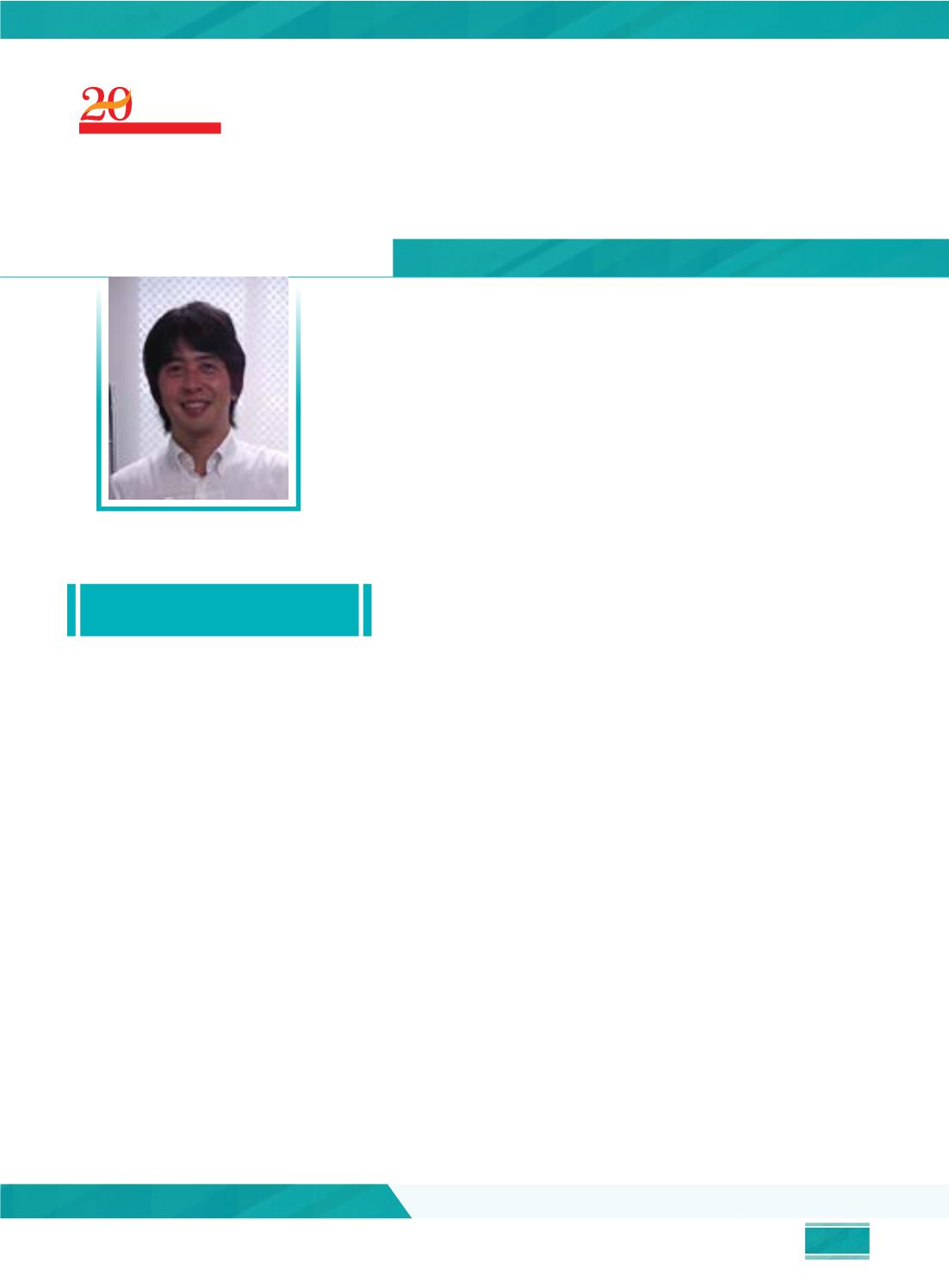
Yuichi Negishi received his PhD Degree from Keio
University, Japan in 2001. He is the Professor of
Tokyo University of Science, Japan. He has over
150 publications that have been cited over 8,000
times. In his publications, 10 papers were catego-
rized to Top 1% cited papers and 18 papers were
selected as cover picture of the journal. His pub-
lication H-index is 45. He has been awarded sev-
eral prizes, including the PCCP Prize in 2007, CSJ
Award for Young Chemists in 2008, Japan Society
of Molecular Science Award for Young Chemists
in 2012 and Yagami Prize in 2017.
negishi@rs.kagu.tus.ac.jpYuichi Negishi
Tokyo University of Science, Japan
BIOGRAPHY