


 2 / 10

Mass Spectrometry Congress 2019
Journal of Chemical Technology and Applications | Volume 3
Page 15
May 20-21, 2019 | Rome, Italy
MASS SPECTROMETRY,
PROTEOMICS AND POLYMER CHEMISTRY
3
rd
International Conference on
OF EXCELLENCE
IN INTERNATIONAL
MEETINGS
alliedacademies.comYEARS
T-PATTERNS, T-STRINGS AND SELF-
SIMILARITY FROM THE RNAWORLD TO
HUMAN MASS-SOCIETIES AND CULTURE: A
BIOMATHEMATICAL CONTINUUM?
T
his research study concerns outcomes of a longstanding primarily etho-
logical (i.e. biology of behavior) project beginning in the early 1970’s
concerning social interaction and organization in social insects and primates
including humans and inspired mainly by the work of K. Lorenz, K. von Frisch
and N. Tinbergen for which they shared a Nobel Prize in Medicine or Physi-
ology in 1973. The smallest animals they studied were social insects with no
implication of nano scale actors or self-similarity. The present project has fo-
cused on developing pattern definitions and corresponding detection tools
resulting in the T-pattern, a self-similar fractal-like pattern recurring with
statistically significant translation symmetry, and corresponding detection
algorithms implemented in the dedicated THEMETM software. This has al-
lowed abundant detection of T-patterns in human, animal and neuronal in-
teractions bringing to light T-patterned temporal self-similarity across more
than nine orders of magnitude in interaction between and within brains and
spatial between T-patterned strings (calledT-strings), notably, DNA and texts.
The RNA world invented its evolving external memory as the purely informa-
tional T-patterned DNA strings and now there is only a DNA world. Similarly,
humans created their evolving external memory as the purely informational
T-strings of written language and thus in a biological eye blink made possi-
ble the development of modern science and technology and now the only
big-brain mass-societies are text based. Only mass-societies in proteins and
human rely on such voluminous durable “stringomes“ external to their citi-
zens where various sub-sets are massively copied, distributed, interpreted,
promoted and even enforced for the creation of specialized citizens, tools
and materials. Extensive temporal and spatial self-similar patterning thus ex-
ist from nano to human scales all patterned in a way reflecting the ancient
structure of their nano scale predecessors, an unbroken biomathematical
continuum from the RNA world to modern human societies and culture.
Magnus S Magnusson, J Chem Tech App 2019, Volume 3
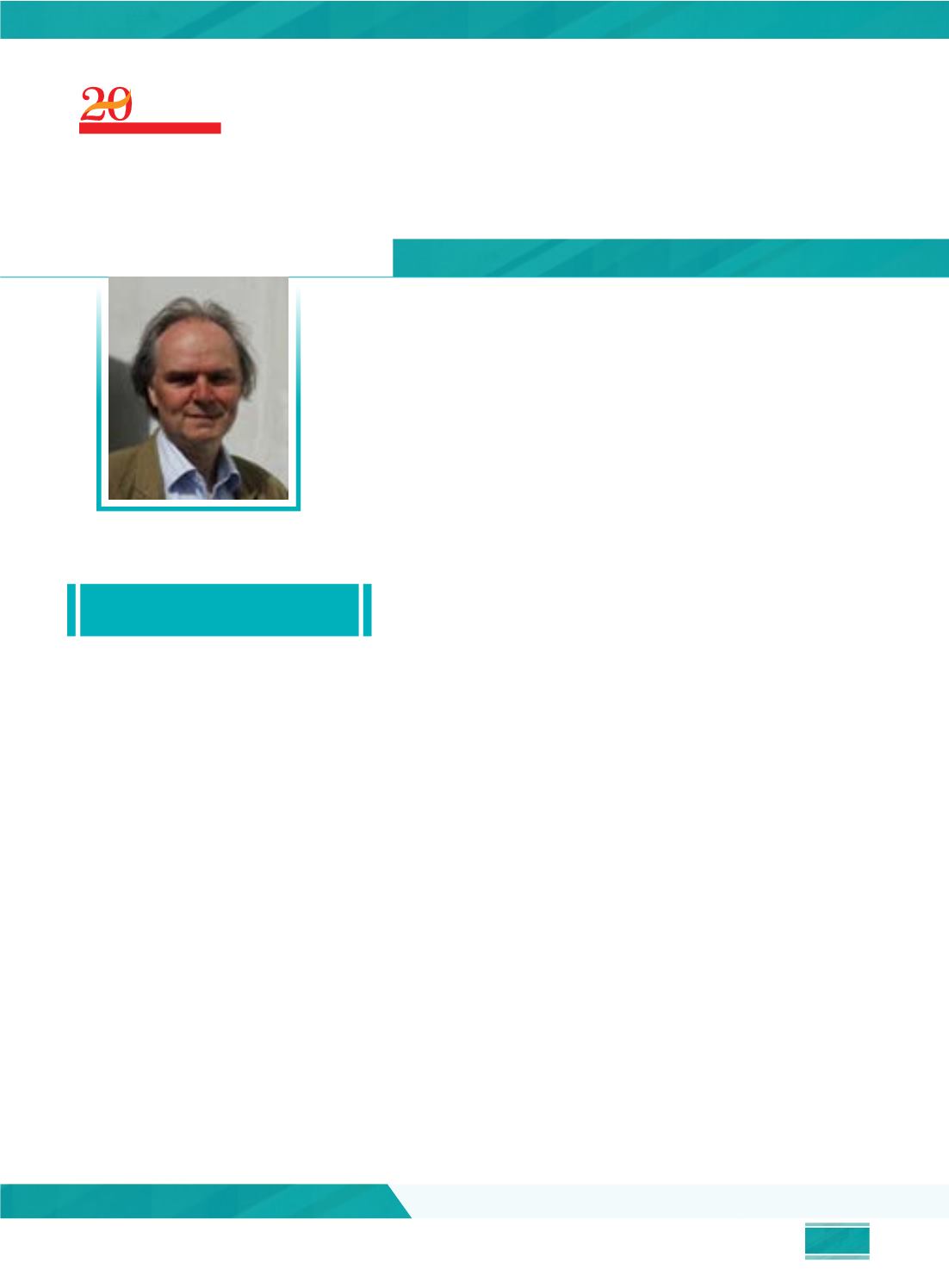
Magnus S Magnusson completed his PhD at Uni-
versity of Copenhagen in 1983. He is a Research
Professor, Founder and Director of the Human
Behavior Laboratory, University of Iceland. He
is the author of the T-pattern model and detec-
tion software THEMETM, focused on real-time
organization of behavior. He was co-directed a
two-year DNA analysis project and presented
numerous papers and talks in ethology, neuro-
science, mathematics, religion, proteomics, mass
spectrometry and nanoscience. He was Deputy
Director at Museum of Mankind during 1983 to
1988, National Museum of Natural History, Paris.
He is a repeated invited Professor at the Universi-
ty of Paris (V, VIII and XIII). Since 1995, he focused
on collaboration between 40 universities based
on “Magnusson’s Analytical Model” initiated at
the Sorbonne, Paris.
msm@hi.isMagnus S Magnusson
University of Iceland, Iceland
BIOGRAPHY