


 2 / 3
2 / 3

Analytical Chemistry 2019
Page 12
November 20-21, 2019 | Berlin, Germany
OF EXCELLENCE
IN INTERNATIONAL
MEETINGS
alliedacademies.comYEARS
ANALYTICAL CHEMISTRY AND
CHROMATOGRAPHY METHODS
2
nd
International Conference on
Journal of Chemical Technology and Applications | Volume 3
TRACE ANALYSIS WITHIN RICH AND VARI-
ABLE MATRICES USING GC-MS WITH HIGH
RESOLUTION MULTI-REFLECTING TOFMS
G
C-MS remains an important part of analytical armory and is indispens-
able in forensic, environmental and food control area. While major com-
ponents are detected with low cost single quadrupoles (GCQ), trace analyses
of minor components require MS tandems like 3Q or Q-TOF to reduce ma-
trix interferences. Matrices of volatiles in GCMS, though are less diverse than
those in LC-MS, still contain thousands of compounds particularly, in food,
clinical and biological samples. Matrix diversity grows roughly proportional
to the analysis depth. To detect minor traces (fg levels) within rich matrices, it
takes both sensitivity and specificity; a combinationwhich is not yet available
in existing commercial instruments. Although the detection limit of detec-
tion (LOD) of GCQ in SIMmode to pure samples is in the 1-10fg range, matrix
interferences limit the working LOD to 10-100pg. 3Q and Q-TOFs then step in
to allow LOD in 100fg range. With GC-3Q instrument MRM methods are de-
veloped to find fragmentation channels which do differentiate analytes from
the matrix. However, a limitation is that whenever matrix varies the original
MRM methods have to be requalified or redeveloped. GC-3Q data alone are
insufficient for court cases and GC-3Q is a poor choice when searching un-
knowns (spices, poisoning etc.). GC-MRTOF is a joint effort of two companies,
MSC andQTek, who developedGCQMaestro™ andGC-Mini™, both delivering
LOD around 1-3fg for pure samples. GC-Mini™ is a compact multi-reflecting
TOF (MRTOF) benchtop system with moderately high-resolution R=30,000.
This resolution is sufficient to separate isobaric interferences corresponding
to such elemental replacements as C/H
12
(95mDa), C
2
H
6
/NO (88mDa), C
2
H
8
/
O
2
(55mDa), CH
4
/O (36mDa) and CH
2
/N (12mDa) for GC-MS small mass ions
up to 500amu. The GC-MRTOF instrumental configuration provides: The
specificity comparable to existing GC-3Q and GC-QTOF; much cleaner chro-
matographic traces by resolving out isobaric interferences; NIST identifiable
spectra are obtained at 10-100fg loads, and molecular ions can be detected
Anatoly Verenchikov, J Chem Tech App 2019, Volume 3
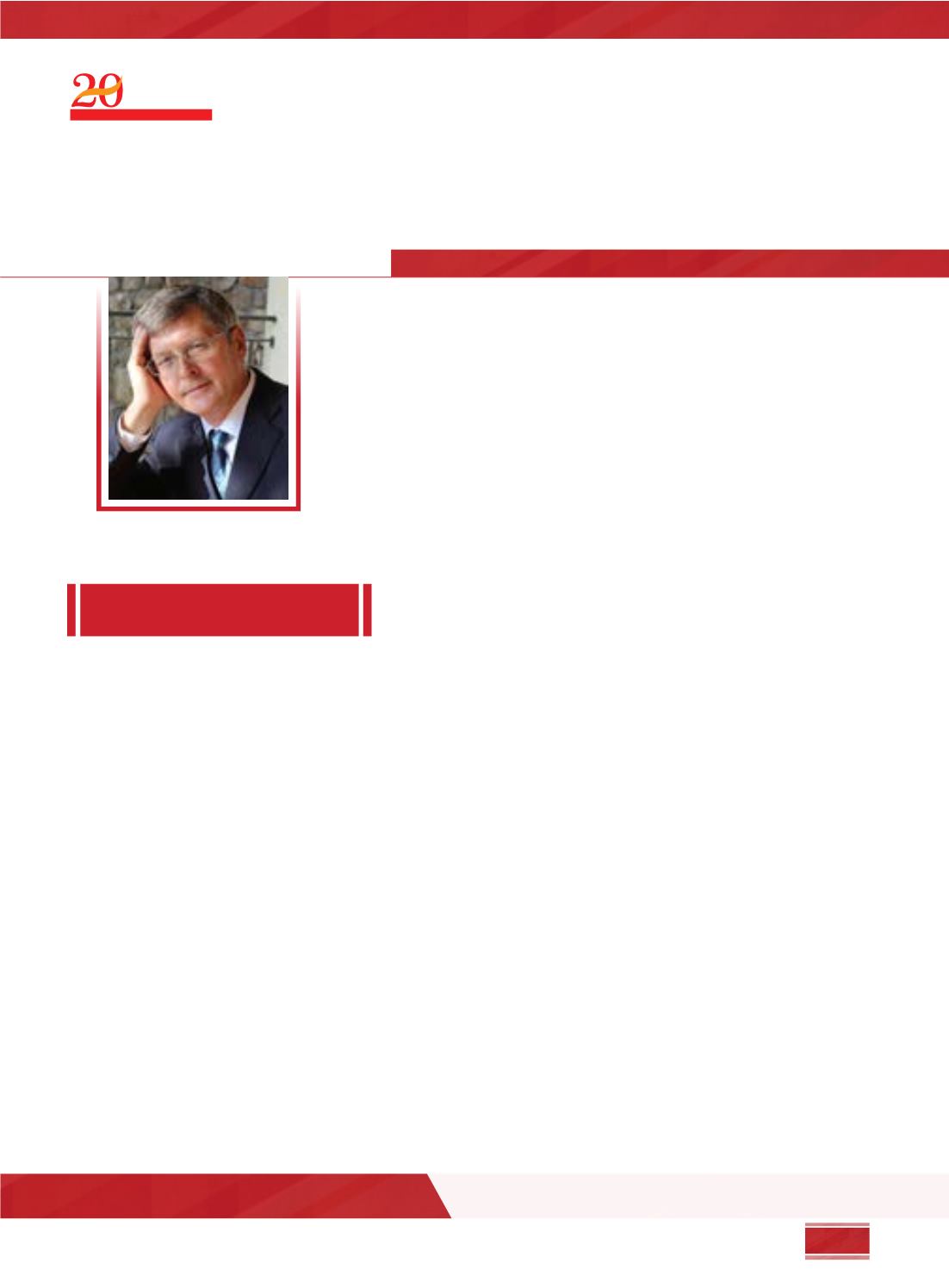
Anatoly Verenchikov is currently the Director of
“Mass Spectrometry Consulting Ltd.” Bar, Mon-
tenegro and served as the Founder for the com-
pany from 2007-2016. In 2015, he received the
Golden medal of the Russian Society of Mass
Spectrometry for outstanding achievements in
mass spectrometry, Moscow, Russia. He also re-
ceived the Golden award of Pittsburg Conference
for Pegasus MRTOF, USA in 2011. He is the author
of over 50 patents, more than 200 papers and
conference presentations.
anatoly.verenchikov@gmail.comAnatoly Verenchikov
Mass Spectrometry Consulting Ltd., Montenegro
BIOGRAPHY
Keynote Forum | Day 1